

Quality and certifications
Qualityan agri-food company in Kairouan certified ISO 9001 and ISO 22000
Carthage Food is certified ISO 9001 for quality management and ISO 22000 for food safety, by Quality Austria. Halal certificate no. 009/2026 covers the harissa, tomatoes, sauces, jams and most legumes. Harissa also carries the Food Quality Label Tunisia.
The range's certifications and labels
Control of quality and food safety is a central element of Carthage Food's production system. The company relies in particular on ISO 9001, the quality management system, and ISO 22000, the food safety management system. The ISO 9001 and ISO 22000 certifications cover the plant, so every Cap d'Or and Fnare product. The Halal logo and the Food Quality Label Tunisia apply to specific products. Each card shows what it covers.

ISO 9001
Quality management. Certified by Quality Austria, no. Q-10770/0.
Whole plant
No. Q-10770/0
View the certificate (PDF, 773 KB): ISO 9001
ISO 22000
Food safety management. Certified by Quality Austria, no. 00142/0.
Whole plant

Halal
Certificate from the Grand Mufti of the Republic and INNORPI, to Tunisian standard NT 124.66 (2020): Cap d'Or and Fnare harissa, tomatoes, sauces, jams and most legumes.
Products concerned
No. 009/2026
View the certificate (PDF, 456 KB): Halal
Food Quality Label Tunisia
The Tunisian label for superior-quality harissa made from fresh chilli. Ministry of Industry decision of 3 June 2025.
Products concerned
ISO 9001 and ISO 22000 certificates issued by
What the press reported
Three public articles about the quality label of Carthage Food's harissa, to open and check.
Managers ·
« Deux entreprises obtiennent la marque tunisienne de qualité pour leur harissa »
On 16 June 2025, the Ministry of Industry, Mines and Energy awarded the Tunisian quality mark for harissa to two companies, Carthage Food among them.
Read the article : Managers, Deux entreprises obtiennent la marque tunisienne de qualité pour leur harissaEntreprises Magazine ·
« Tunisie – Harissa : COMOCAP et Carthage Food, premières entreprises labellisées »
On 16 June 2025, the Ministry of Industry, Mines and Energy awarded the Tunisian quality mark for harissa to two companies, Carthage Food among them.
Read the article : Entreprises Magazine, Tunisie – Harissa : COMOCAP et Carthage Food, premières entreprises labelliséesKapitalis ·
« Food Quality Label Tunisia : cinq entreprises de harissa certifiées »
On 22 January 2016, the Minister of Industry awarded the Food Quality Label Tunisia to five harissa companies, Carthage Food among them for Cap d'Or.
Read the article : Kapitalis, Food Quality Label Tunisia : cinq entreprises de harissa certifiées
What our labels tell you
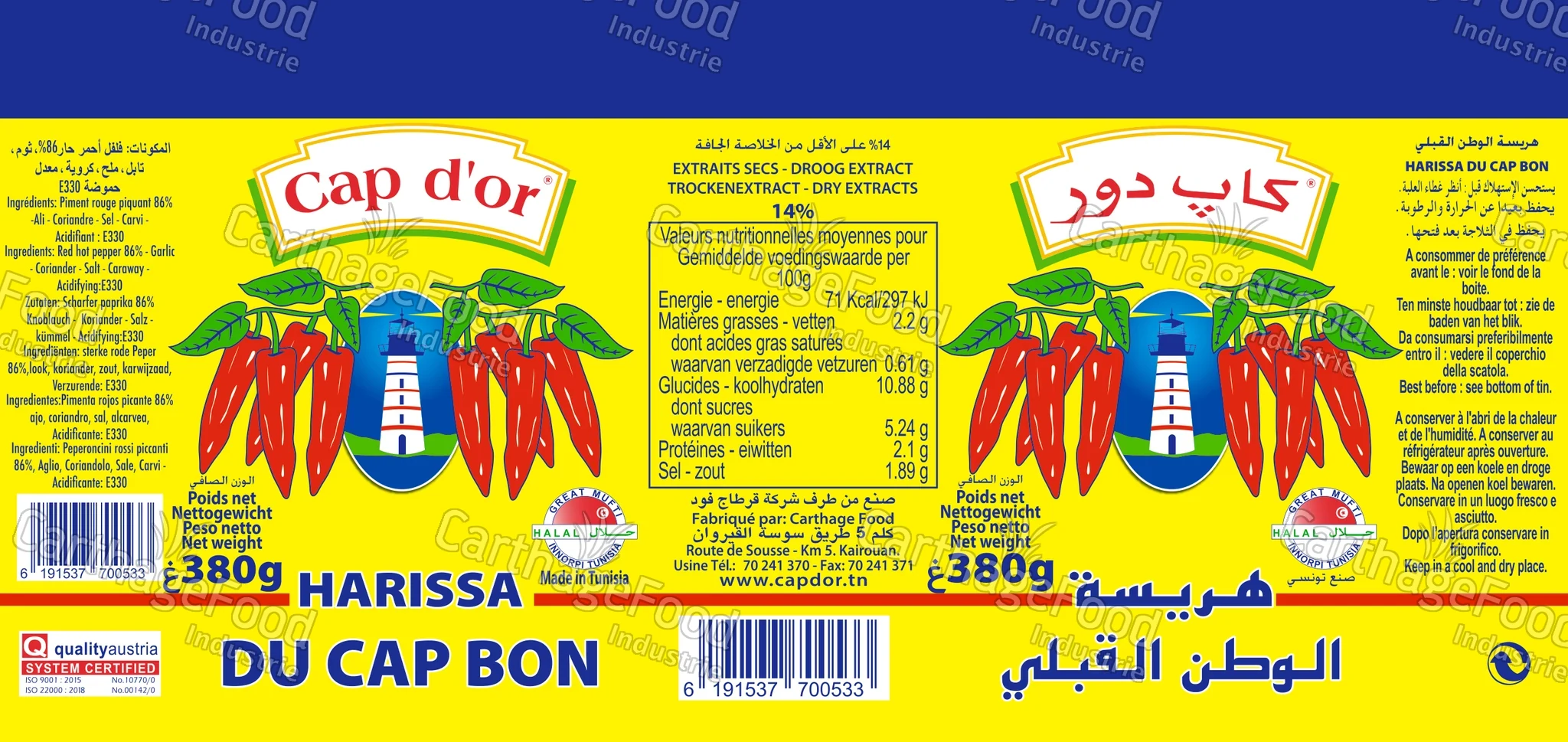
- Short ingredient listsHarissa contains hot red chilli (86%), garlic, coriander, salt, caraway and an acidity regulator (E330). Double tomato concentrate contains 100% fresh tomatoes.
- Nutrition per 100 gThe labels on harissa, double tomato concentrate, jams and beans give average values per 100 g: energy, fat, carbohydrate, sugars, protein and salt.
- Several languages on every tinEvery product is labelled in French, Arabic and English. Harissa adds German, Dutch, Italian and Spanish.
- An EAN-13 code for every formatEvery format has its own EAN-13 code: harissa in 135 g and harissa in 2 kg each have their own. A code not yet shown on a product page is sent on request.
Checks all along production
Production at Carthage Food follows its ISO 9001 and ISO 22000 management systems. Here are the main control stages, from intake to shipment.

Step 1. Intake checks
Raw materials and packaging are checked on arrival at the plant.

Step 2. Process control
Each manufacturing stage is monitored under the plant's food safety plan.

Step 3. Seam checks
Can seams are checked to make sure every tin is sealed tight.

Step 4. Heat treatment
The tins go through a heat treatment suited to each product, which preserves them.

Step 5. Finished product and traceability
Finished products are checked before they leave the plant. Every batch stays traceable through to shipment.
The plant's laboratory, in pictures
These pictures were taken in the laboratory of the Carthage Food plant in Kairouan. They show measurements made on Cap d'Or double tomato concentrate.

Dry extract: the refractometer
The refractometer measures the dry extract of the concentrate, in degrees Brix. In the picture it reads 28.4 °Brix. The Cap d'Or double concentrate label states 28 to 30% dry extract.

Acidity: the pH meter
The probe of the pH meter is dipped into the concentrate to measure its acidity.

Temperature: the probe thermometer
A probe thermometer checks the temperature of the product, tin open.

Stability: the oven at 37 °C
Tins are kept in the oven for the stability test. The notice on the oven states the reference method NF V 08-408 and the temperature of 37 °C.
Heritage: harissa, a recognised craft
Harissa has been on UNESCO's list of the Intangible Cultural Heritage of Humanity since 2022. Cap d'Or and Fnare harissa carries the Food Quality Label Tunisia. Carthage Food is one of the five companies that received this label on 22 January 2016. Carthage Food also takes part in the national effort to promote quality Tunisian harissa.
Quality and certifications
Is Carthage Food ISO 22000 certified?
Yes. Carthage Food holds ISO 22000 for food safety (Quality Austria, no. 00142/0) and ISO 9001 for quality management (Quality Austria, no. Q-10770/0). Both certifications are printed on every Cap d'Or and Fnare label. The ISO 9001 and Halal certificates can be downloaded from the Quality page, and a copy of the ISO 22000 certificate is sent on request through the Contact page.
Is Cap d'Or harissa halal?
Yes. The Cap d'Or and Fnare harissa label carries the Halal logo of the Grand Mufti of the Tunisian Republic and INNORPI. The Halal logo also appears on Cap d'Or double tomato concentrate and sauces. Halal certificate no. 009/2026 also covers the jams and most canned legumes; red beans are not included.
What is the Food Quality Label Tunisia?
The Food Quality Label Tunisia is a Tunisian quality label for harissa made from fresh chili. Cap d'Or and Fnare harissa by Carthage Food carries this label. It was awarded on 22 January 2016 to five companies, Carthage Food among them: the tin recalls it with the words "one of 5 labelled harissas".
Is harissa on the UNESCO heritage list?
Yes. Harissa has been on UNESCO's list of the Intangible Cultural Heritage of Humanity since 2022. Carthage Food makes this Tunisian harissa in Kairouan under the Cap d'Or and Fnare brands.
Where can I find Carthage Food's certificates?
The ISO 9001 and Halal certificates and the Food Quality Label can be downloaded in PDF from the Quality page and the Documents page, with their number. A copy of the ISO 22000 certificate is sent on request through the Contact page.
Worth reading
All articles

Cap d'Or jams: eight flavours, from apricot to prickly pear
Cap d'Or makes eight jams: apricot, quince, fig, prickly pear, strawberry, orange, pear and apple. What each label says, and ideas for using them.4 min read
At the Kairouan plant: double tomato concentrate, in pictures
From the trucks of fresh tomatoes to the warehouse: pictures taken at the Carthage Food plant in Kairouan follow a tin of Cap d'Or double tomato concentrate.3 min read


