
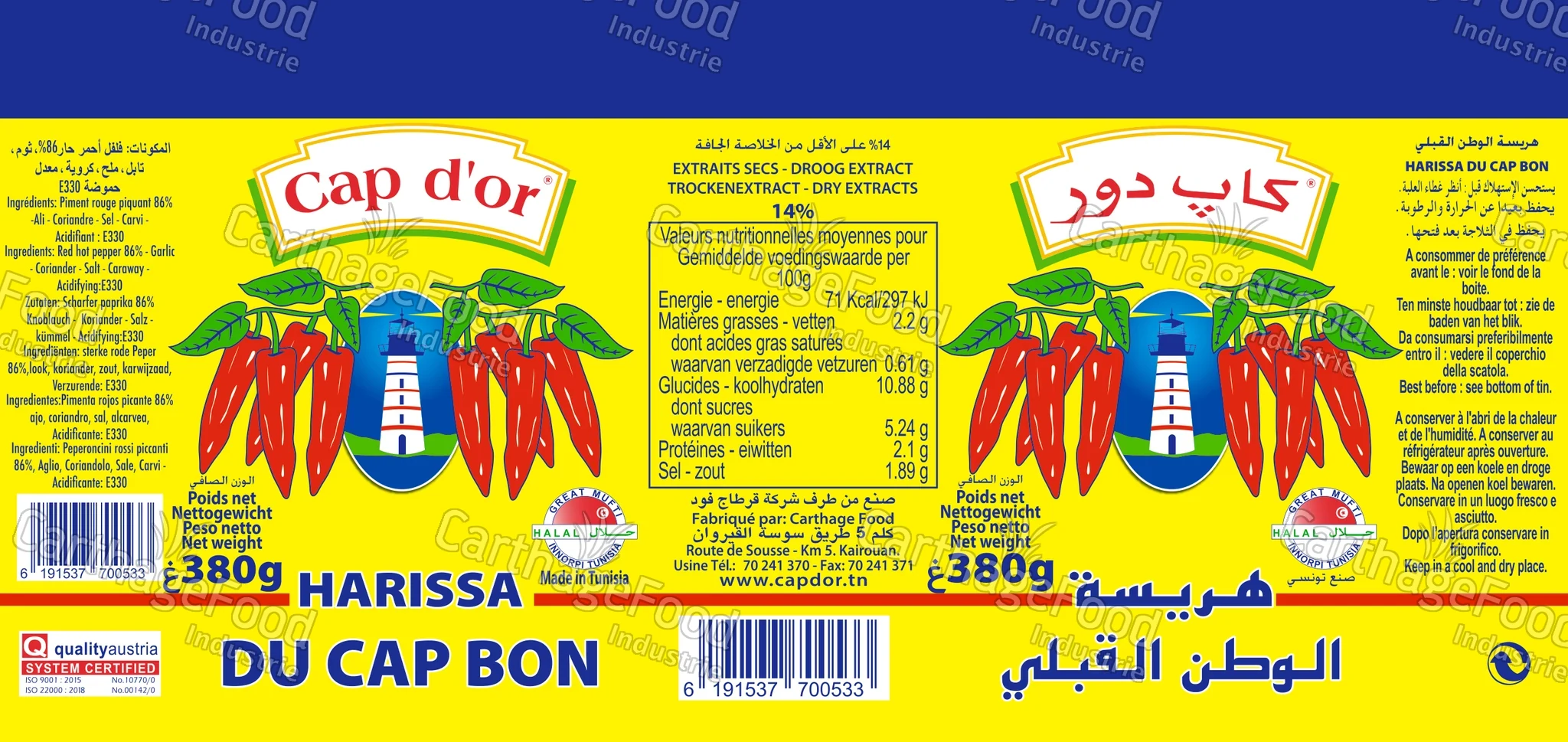
A harissa label can be read in six steps: the share of chilli, the order of ingredients, the dry extract, the additives, the nutrition table, then the logos and barcode. The share of chilli is the first sign of quality. On Cap d'Or and Fnare harissa, it reaches 86%. This guide uses the label of the 380 g Cap d'Or harissa as its example.
How much chilli should a harissa contain?
Chilli is what makes harissa. Its percentage appears in the ingredient list, right after its name. In the European Union, Regulation (EU) No 1169/2011 requires the quantity of the characterising ingredient to be shown. The higher the figure, the more the harissa takes its flavour from the chilli itself. Cap d'Or and Fnare harissa states “red hot pepper 86%”.
How do you read the ingredient list?
Ingredients are listed in descending order of weight at the time of manufacture, so the first one named is the largest. Here is the list printed on Cap d'Or and Fnare harissa:
- red hot pepper 86%;
- garlic;
- coriander;
- salt;
- caraway;
- acidifier: E330.
Six entries are enough, and they match the Tunisian recipe. The list mentions no oil, no added sugar and no colouring.
What does a 14% dry extract mean?
Dry extract measures the solid matter in the product, in other words what remains once the water is removed. It tells you how concentrated and how thick the harissa is. Do not confuse it with the share of chilli. The 86% refers to one ingredient. The 14% dry extract refers to the solid matter of the whole harissa.
What is E330 on a harissa label?
E330 is citric acid in the European system of food additives. It occurs naturally in citrus fruit. In harissa, it regulates acidity. On the Cap d'Or label it appears as “acidifier: E330”. It is the only additive in the recipe.
How do you read the nutrition table?
Values are given per 100 g, which makes it easy to compare two products. These are the average values printed on Cap d'Or harissa:
- energy: 297 kJ / 71 kcal;
- fat: 2.2 g, of which saturates: 0.61 g;
- carbohydrate: 10.88 g, of which sugars: 5.24 g;
- protein: 2.1 g;
- salt: 1.89 g.
Harissa is a condiment: you eat a few grams, not 100 g. A 10 g serving provides about 7 kcal and 0.19 g of salt. The sugars come from the ingredients themselves, as the list contains no added sugar.
What do the logos on the label tell you?
- The Tunisian Halal logo, issued with the Grand Mufti of the Republic and INNORPI, the national institute for standards and industrial property.
- The Food Quality Label Tunisia, the label for harissa made with fresh chilli. It was awarded to five companies, Carthage Food among them, on 22 January 2016.
- ISO 9001 and ISO 22000, which certify the plant's quality and food safety management.
The label is printed in French, Arabic, English, German, Dutch, Italian and Spanish.
What is the EAN code for?
The EAN-13 code is the 13-digit barcode scanned at the till. Each format has its own. The 380 g Cap d'Or harissa carries the code 6191537700533. The 619 prefix is the one GS1 assigns to Tunisia. It shows which body issued the code, not necessarily where the product was made. For a trade buyer, the EAN makes it easy to list the right format without error.
Cap d'Or and Fnare harissa, label in hand
Carthage Food makes its Cap d'Or and Fnare harissas in Kairouan, Tunisia. The recipe and nutrition table are the same from the 135 g to the 760 g tin. Each label shows the share of chilli, the dry extract, the plant's certifications and the EAN code of the format. The product pages on this site list the same information, format by format.


